Date Published: 21/03/2022
A golf handicap is one of the most useful tools in the game. It allows golfers of different abilities to compete fairly, track progress over time, and measure performance on any course in the world. And with club membership no longer required to hold an official handicap, it has never been more accessible.
This guide explains exactly how the World Handicap System calculates your Handicap Index in the UK. You will learn how Score Differentials work, how your best rounds are used, and how to calculate your Course Handicap using the latest formula updates.
If you are a non club golfer, you will also see how to get a Handicap Index through iGolf.
Quick Answer: How is a golf handicap calculated?
- Your Handicap Index is based on your best 8 Score Differentials from your last 20 rounds
- A Score Differential measures how you performed relative to the course difficulty
- It uses Adjusted Gross Score, Course Rating, Slope Rating and PCC
- Your handicap updates automatically after each submitted score
The golfing terms you need to know
Before diving into the calculations, it helps to understand the building blocks. These values are pre-calculated for every rated course and available via the R&A Course Rating and Slope Database (you never need to work them out yourself).
- Bogey Rating – The measure of playing difficulty from a set of tees when played by a Bogey Golfer (a player with a Course Handicap of approximately 20 for a male and 24 for a female)
- Course Rating – The measure of how many strokes a Scratch Golfer should take on any given course (a player who can play to a Course Handicap of 0 on all rated golf courses)
- Slope Rating – A number between 55 and 155 indicating how much more difficult a course is for a bogey golfer relative to a scratch golfer. The standard benchmark is 113. The higher the Slope Rating, the more strokes a higher-handicap player is likely to need.
- Adjusted Gross Score (AGS) – Your actual score for the round, with individual hole scores capped at Net Double Bogey (par + 2 + any handicap strokes you receive on that hole). This stops one blow-up hole from distorting your handicap.
- Playing Conditions Calculation (PCC) – A daily adjustment between -1 and +3 that accounts for how conditions on the day affected scoring across the field. It is calculated automatically by the WHS from all scores submitted that day, you do not set it yourself.
- Score Differential – The number produced from each round you play, representing your performance relative to the expected standard on that course. It is the core unit your handicap is built from.
How is your golf handicap index calculated?
Your Handicap Index is a portable measure of your playing ability that works on any rated course in the world. Here is how the WHS calculates it.
Step 1: Calculate a Score Differential for Each Round
For every round you submit, the WHS works out a Score Differential:
Score Differential = (113 ÷ Slope Rating) × (Adjusted Gross Score − Course Rating − PCC)
This tells you how you played relative to a course of standard difficulty. The lower the differential, the better you played.
Example: Calculating a Score Differential
To make this clearer, here is a simple example:
- Adjusted Gross Score: 92
- Course Rating: 71.5
- Slope Rating: 125
- PCC: 0
Score Differential = (113 ÷ 125) × (92 − 71.5 − 0)
Score Differential = 0.904 × 20.5 = 18.5
This means your performance in that round is equivalent to playing 18.5 over par on a course of standard difficulty. The lower the number, the better the performance.
Step 2: Build Your Scoring Record
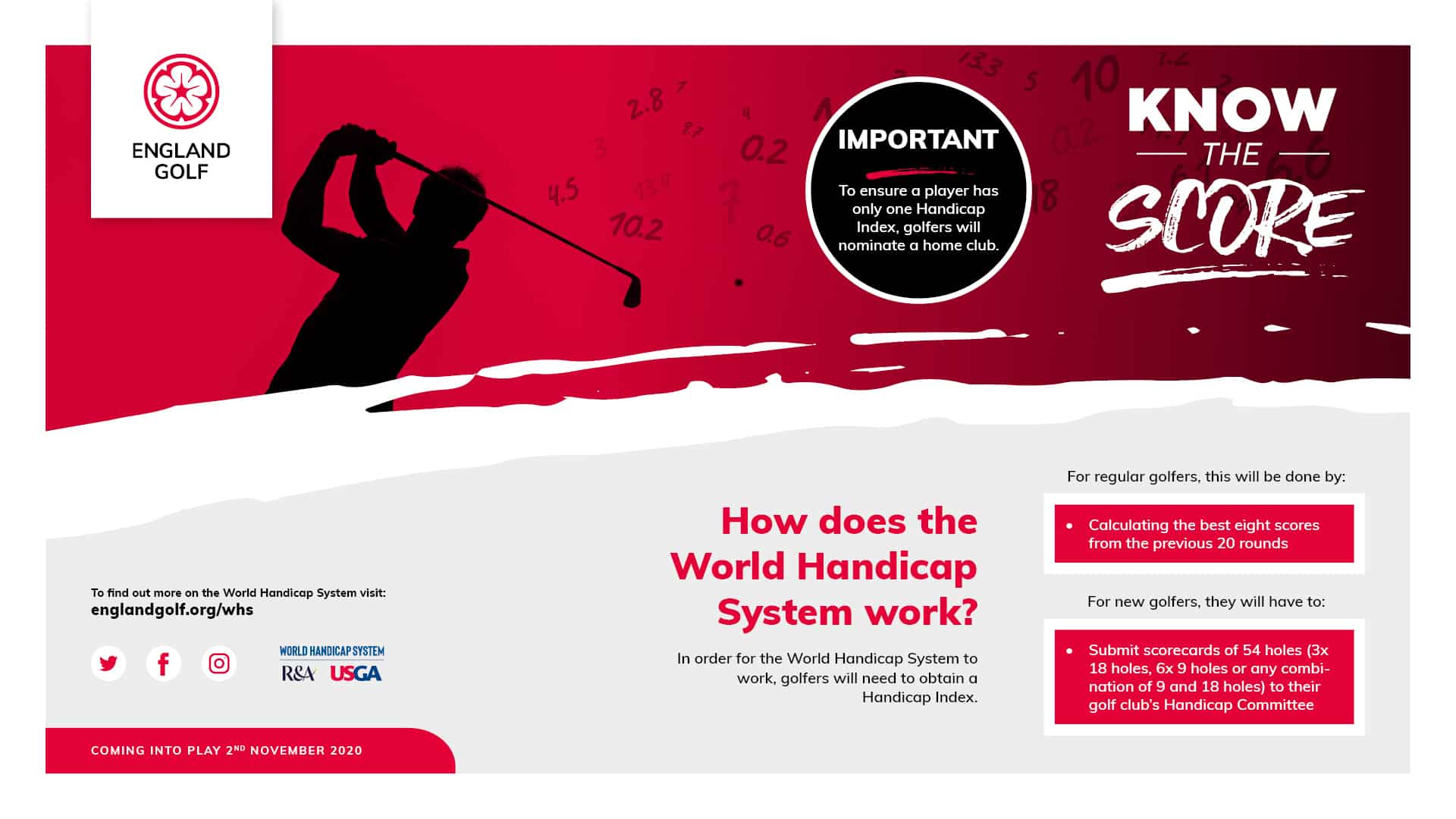
Each differential is added to your Scoring Record. The system looks at your most recent 20 rounds. If you have fewer than 20, a scaled approach applies:
- 3–5 rounds: lowest 1 differential used
- 6–8 rounds: lowest 2
- 9–11 rounds: lowest 3
- 12–14 rounds: lowest 4
- 15–16 rounds: lowest 5
- 17–18 rounds: lowest 6
- 19 rounds: lowest 7
- 20 rounds: lowest 8
You need a minimum of 54 holes (any combination of 9 or 18-hole rounds) to receive your first Handicap Index through iGolf.
Step 3: Average Your Best Differentials
Once you have 20 rounds, the WHS takes your 8 lowest Score Differentials and averages them to produce your Handicap Index.
Your Handicap Index is not your average score. It reflects your potential at your best.
Handicap Safeguards: Soft Cap and Hard Cap
To prevent a handicap rising too sharply during a poor run of form, the WHS applies two automatic limits based on your Lowest Handicap Index (LHI) from the previous 12 months:
Soft Cap – If your index would increase more than 3.0 above your LHI, any rise beyond that point is cut by 50%. So a potential increase of 5.0 above LHI becomes 4.0 instead.
Hard Cap – Your Handicap Index can never rise more than 5.0 above your LHI, regardless of scores submitted.
Exceptional Score Adjustments
If you post a notably low score relative to your current Handicap Index, the WHS applies an automatic downward adjustment across your last 20 differentials:
- −1 reduction applied when your Score Differential is 7.0 to 9.9 below your Handicap Index
- −2 reduction applied when your Score Differential is 10.0 or more below your Handicap Index
This phases out gradually over the next 20 rounds as new scores come in.
How is my course handicap calculated?
Your Handicap Index is a general measure of ability. Before each round, it needs to be converted into a Course Handicap – a figure specific to the course and tees you are playing that day.
Important: the Course Handicap formula was updated in April 2024. If you have seen the old formula elsewhere, it is out of date.
Course Handicap = (Handicap Index × Slope Rating ÷ 113) + (Course Rating − Par)
The addition of (Course Rating − Par) brings the UK in line with how the WHS operates globally, and means your Course Handicap now aligns directly with your scoring target on the day. If the Course Rating is higher than par, you receive extra strokes. If it is lower, you receive fewer.
Your Course Handicap is calculated automatically on the MyEG app and displayed on the board at the first tee at most clubs.
What Is a Playing Handicap?
Your Course Handicap is not always the number of strokes you receive in a competition. Most formats apply a percentage allowance to produce your Playing Handicap:
- Individual Strokeplay or Stableford: 95%
- Fourball Better Ball: 85% (stroke) or 90% (match)
- Foursomes: 50%
- Greensomes: 60/40 split
So if your Course Handicap is 20 and you are playing individual Stableford, your Playing Handicap is 19 (20 × 95%, rounded).
I’m not a club member golfer – How do I get a handicap?
If you want an official Handicap Index without joining a club, iGolf is the solution. It is designed specifically for non-member and recreational golfers, and gives you everything you need to track your game and compete.
How to get started:
- Subscribe to iGolf (£47 for 12 months)
- Download the MyEG app
- Submit scores from a minimum of 54 holes — any combination of 9 or 18-hole rounds on any rated course
- Your official Handicap Index is calculated and updated automatically after every round
What’s included with iGolf:
- Official WHS Handicap Index, recognised worldwide
- Score tracking and handicap history via the MyEG app
- Public liability insurance included
- Access to England Golf updates, offers and events
- Submit scores on any rated course in England, Scotland, Wales or Ireland